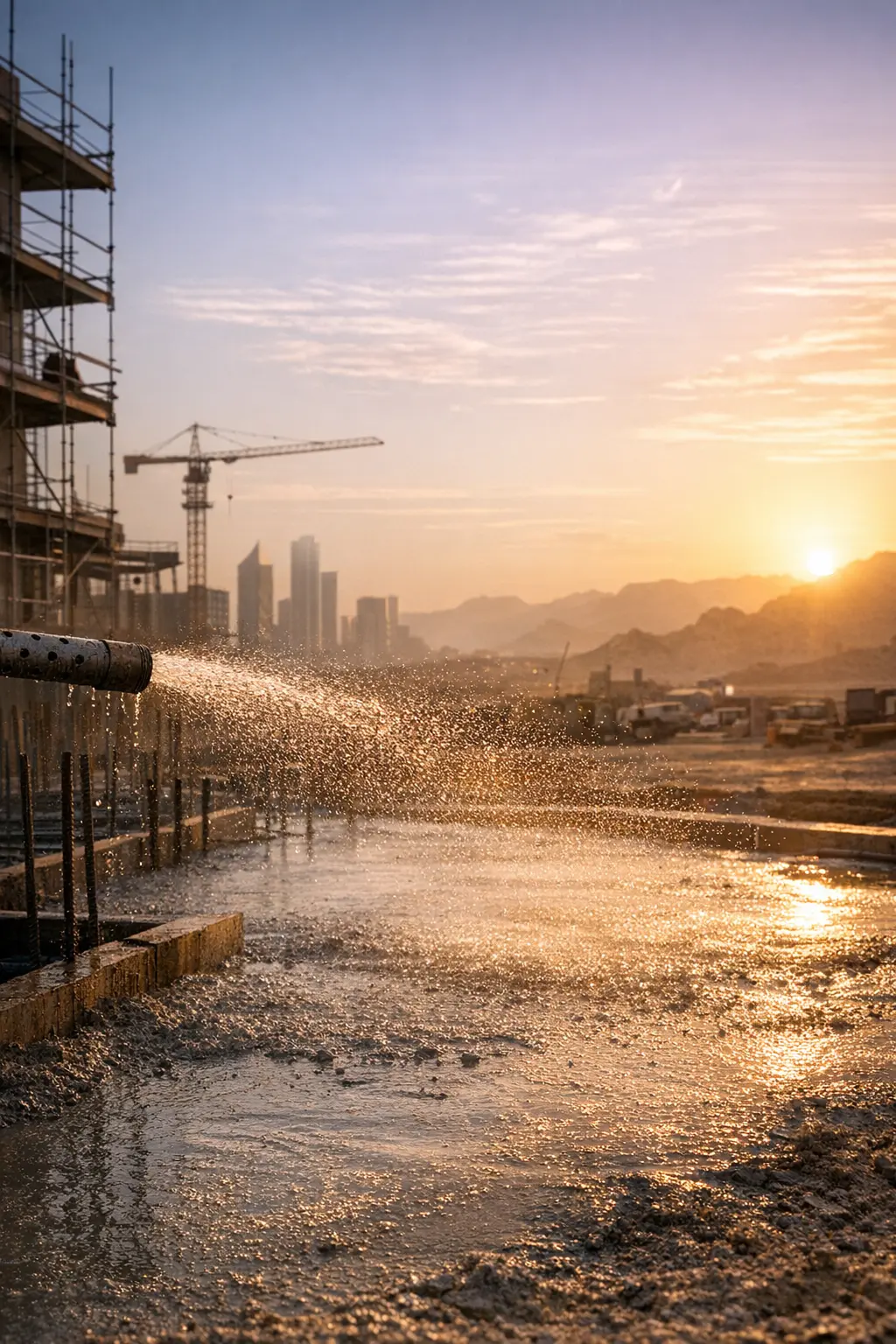
Why Concrete Curing Is Important lies in its role in maintaining proper moisture and temperature levels in freshly poured concrete, allowing hydration to occur correctly. Effective curing prevents early drying, cracking, and durability loss, ensuring stronger, longer-lasting concrete—especially critical in hot desert climates like Saudi Arabia’s construction environment
The Science of Hydration and Structural Integrity
At its core, concrete does not “dry” in the traditional sense; rather, it hardens through a complex chemical reaction between cement and water. This process, termed hydration, creates a crystalline structure that binds the aggregates together. If the water required for this reaction evaporates too quickly due to wind or heat, the hydration process is interrupted, leaving the concrete weak and porous. This is the primary reason why professional contractors emphasize curing as a non-negotiable step in any high-stakes building project.
For investors entering the Saudi market, the structural integrity of a building is the most significant factor in asset valuation. Properly cured concrete can achieve a compressive strength that is significantly higher—sometimes up to 50% more—than concrete that has been poorly maintained during its initial setting period. By ensuring that the hydration process remains continuous, the concrete matrix becomes denser and more capable of supporting the heavy loads required for modern skyscrapers, bridges, and industrial warehouses across the Kingdom.
Preventing Plastic Shrinkage and Surface Cracking
One of the most immediate answers to Why Concrete Curing Is Important is the prevention of plastic shrinkage cracks. These cracks occur when the rate of surface evaporation exceeds the rate at which bleed water rises to the surface. In the high-temperature environment of Saudi Arabia, this phenomenon can happen within minutes of finishing. Curing acts as a protective shield, maintaining a moist surface that resists the internal stresses caused by volume changes during the early stages of hardening.
Beyond aesthetics, these cracks represent a significant structural risk. Even hairline fractures can provide a direct pathway for harmful chemicals, moisture, and oxygen to reach the internal steel reinforcement. Once the rebar begins to corrode, the expansion of the rust causes the concrete to spall and fail. Therefore, rigorous curing protocols are the first line of defense in protecting the “skeleton” of a building from environmental degradation, ensuring that the investment remains secure for decades.
Enhancing Durability in High-Salinity Environments
In coastal regions such as Jeddah, Dammam, and NEOM, the air is thick with chlorides and moisture. Here, the importance of curing shifts toward permeability control. Well-cured concrete has a much tighter pore structure, which significantly reduces the ingress of water and salt ions. This “waterproofing” effect is natural and inherent to the material’s chemistry, provided it is given the time and environment to develop correctly through professional curing techniques.
For foreign investors, the durability of a structure translates directly to lower maintenance costs. A building constructed with high-performance, well-cured concrete will resist the “concrete cancer” or carbonation that plagues many older structures in the Gulf region. By prioritizing these engineering standards today, stakeholders can avoid the massive financial burden of structural rehabilitation in the future, making the project more attractive for long-term commercial or residential leasing.
Why Concrete Curing Is Important for Surface Hardness
The surface of a concrete slab is often the part that endures the most wear and tear, especially in industrial settings like factories or logistics hubs. Curing is essential for achieving maximum surface hardness and abrasion resistance. When concrete is properly cured, the surface becomes “dust-free” and highly resistant to the scraping and impact of heavy machinery. Conversely, uncured concrete often results in a soft, chalky surface that wears away quickly, creating maintenance headaches.
In the Saudi industrial sector, where logistics and manufacturing are expanding rapidly, the quality of warehouse flooring is a critical operational factor. Using advanced curing compounds or water-saturated covers ensures that the surface remains dense and durable. This prevents the formation of “laitance”—a weak, milky layer on the surface—and ensures that any subsequent floor coatings, such as epoxies or polyurethanes, bond effectively to the substrate, providing a professional finish that lasts.
Navigating the Saudi Climate: Challenges and Solutions
The climate in Saudi Arabia presents unique challenges that make curing even more vital than in temperate regions. High temperatures, low humidity, and constant desert winds accelerate evaporation rates to dangerous levels. Engineers must follow specific “Hot Weather Concreting” guidelines, such as ACI 305R, which often involve pre-cooling materials or using specialized curing membranes. Understanding these local nuances is what separates successful construction firms from those that face recurring quality issues.
Implementing effective curing strategies in the Kingdom often requires a combination of traditional methods, like ponding or wet burlap, and modern chemical solutions. For instance, liquid membrane-forming compounds are frequently used in large-scale infrastructure where water is scarce. These compounds create a vapor-tight seal over the concrete, locking in the necessary moisture. For investors, partnering with a local expert who understands these environmental variables is essential for meeting the stringent requirements of the Saudi Building Code (SBC).
The Economic Value of Quality Construction
From a financial perspective, the cost of proper curing is negligible compared to the total project budget—usually less than 1%. However, the return on investment (ROI) is substantial. Proper curing reduces the likelihood of “non-conformance reports” (NCRs), which can delay project handovers and trigger expensive legal disputes between contractors and developers. In a market as competitive as Saudi Arabia’s, maintaining a reputation for high-quality, durable construction is the key to winning future government and private tenders.
Furthermore, international investors often look for sustainability and “Green Building” certifications like LEED. Curing contributes to sustainability by extending the life cycle of the building and reducing the need for replacement materials. By focusing on Why Concrete Curing Is Important, developers demonstrate a commitment to Expertise, Experience, Authority, and Trustworthiness (E-E-A-T), which are the hallmarks of world-class real estate development. This attention to detail builds confidence among global partners and financial institutions.
Partnering for Success: Great Success Establishment
In the dynamic landscape of Saudi Arabian construction, achieving excellence requires more than just technical knowledge; it requires a partner dedicated to the highest standards of quality. Great Success Establishment stands as a leader in providing comprehensive construction solutions that prioritize structural integrity and long-term durability. Whether you are an engineer managing a complex site or an investor looking for reliable project execution, Great Success offers the local expertise needed to navigate the region’s unique challenges.
Our team understands that every drop of water and every degree of temperature matters in the curing process. By integrating advanced technology with proven engineering practices, Great Success Establishment ensures that your projects meet and exceed international benchmarks. We are committed to building the future of the Kingdom with a focus on precision, transparency, and unyielding quality. Visit our website to explore how we can support your next major investment in the Saudi construction market.
Frequently Asked Questions (FAQ)
-
How long should concrete be cured for optimal results?
Generally, a minimum of 7 days is recommended for standard concrete, but for high-strength applications or projects in harsh climates like Saudi Arabia, extending this to 14 days or using specialized membranes is often necessary to reach the design strength.
-
Can I skip curing if it rains?
No, rain is unpredictable and may not provide the consistent moisture level required for the hydration process. Moreover, heavy rain on fresh concrete can damage the surface finish. Controlled curing methods are always preferred.
-
What is the most effective curing method for the Saudi climate?
In hot, dry regions, water curing (ponding or misting) is highly effective but water-intensive. Many large projects opt for high-quality chemical curing membranes or plastic sheeting to prevent evaporation without the need for constant water application.
-
Why Concrete Curing Is Important for heavy-duty industrial floors?
Curing ensures the surface achieves maximum abrasion resistance. This prevents the floor from “dusting” and ensures it can withstand the traffic of forklifts and heavy machinery without deteriorating.
-
What happens if concrete is not cured?
Uncured concrete can lose up to 50% of its potential strength, develop deep cracks, and become highly porous, leading to the rapid corrosion of internal steel reinforcements and eventual structural failure.